-
-
Jeanette's Digital Diary
Reporting Industry Trends Using Quantitative Research
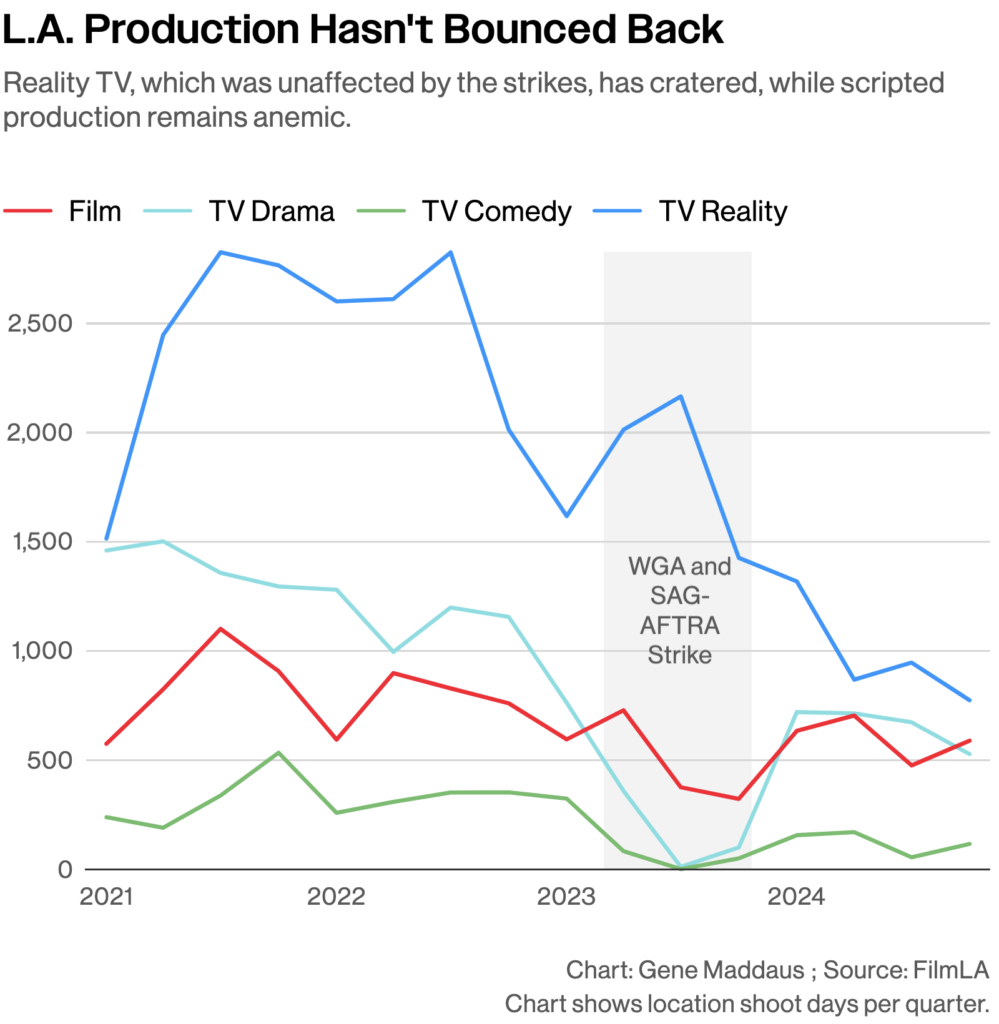 The graph below, originating from the Variety article titled, “After L.A. Fires, Bringing Production Back Has Become More Urgent Than Ever” is an example of quantitative research used to support the writer’s reporting about the state of film and television production after the California wildfires. This graph is an example of quantitative research because it utilizes empirical data to quantify the amount of production by tracking the number of shooting days per quarter. While the graph quantifies the fluctuating amount of production from 2021 to 2024, the article’s authors utilize this quantitative research to support their reporting on the state of film and television production in Los Angeles after the California wildfires. For this article, quantitative research effectively supports the authors’ reporting about production in California in addition to interviews with industry insiders. Personally, I am the type of film student who enjoys reading trade magazines like Variety and The Hollywood Reporter because I am able to learn about multiple current issues that the industry navigates in a more accessible form versus reading academic literature. Furthermore, I enjoy reading film industry trade magazines because I learn more about currently circulating movies and television shows, often directly from […] “Reporting Industry Trends Using Quantitative Research”
 -
-
Jeanette's Digital Diary
Second Wave Feminism and the Male Gaze
 When I read about the numerous types of feminisms, one example of second wave feminism is Laura Mulvey’s notion of the male gaze in cinema from 1975. For this post, I include this still from Michael Bay’s Transformers (2007) featuring Megan Fox. In this frame, Fox is inspecting a vehicle’s inner workings while the camera focuses on her arched back, her revealed skin, and the motion of her body. Even though the action of the scene follows Fox inspecting a car, Mulvey’s notion of the male gaze argues that the camera is most interested in framing Fox’s body for maximum sexual pleasure. In film studies, I learned about the lasting legacy of Mulvey’s feminist film theory work which critically examines how looking is constructed in movies. As a filmmaker, Mulvey’s theory of the male gaze usefully describes the filmmaking conditioned required on set in order to construct a frame like the one from Transformers. On the other hand, when I am in the audience, I feel equipped to identify the filmmaking devices used in order to frame a woman for maximum sexual gratification. Unfortunately, in contemporary cinema, the male gaze is still constantly utilized to signal that a woman in the frame is sexually desirable or will become a […] “Second Wave Feminism and the Male Gaze”
 -
Jeanette's Digital Diary
Organizational Communication In Relation to Film Studies
 In reading about the developments of different perspectives on organizational communication throughout history, I relate the developments emerging from Era of Preparation to the Hays Code era in classical Hollywood cinema history. For some context, Hollywood adapts a self-censorship code across the industry in order to maintain close control over its reputation within the U.S. media industry and maintain profit. I relate this period in classical Hollywood cinema history to the Era of Preparation’s focus on public address and persuasion because this period in Hollywood history proves that the developing understanding about organizational effectiveness and worker productivity was reflected in an industrial context at the time as well. If the Era of Preparation’s focus is in interest of higher profit margins and managerial effectiveness, then the implementation of the Hays code accomplishes those two things at once by implementing a rigorous set of rules for workers in order to protect longer term profit margins. Although I write from 2026, I connect my career in film studies to the contemporary organizational communication discipline’s contention with ethics. Similar to organizational communication, documentary film studies has developed a line of critical inquiry invested in understanding the ethics of documentary filmmaking practices, specifically for […] “Organizational Communication In Relation to Film Studies”
 -
Jeanette's Digital Diary
Zohran Mamdani's Mayoral Campaign During Group Termination Phase
 From the New York Times piece titled, “Zohran Mamdani’s Inner Circle,” this image in conjunction with the article illustrate the notion that a group goes through phases beginning with formation and ending with termination. For context, this piece was published in August 2025, before Zohran Mamdani won the mayoral election. While this image is intended to inform a reader about the people Mamdani surrounds himself with, I focus on the portion of the image which features the individuals making up Mamdani’s campaign staff, who comprise a group with the typical stage developments of a group beginning with forming and ending with terminating. For this example, I focus on forming and terminating because these two phases occur most publicly for this group specifically. The staff comprising Zohran Mamdani’s campaign team formed a group with the goal of accomplishing the mayoral election in Mamdani’s favor and the group reached the termination phase when the mayoral election took place. Although the group secured Mamdani’s win and accomplished their goal, the group reached termination phase once the election began because by then they had reached their deadline. As a voter, I clearly remember that Zohran Mamdani’s campaign team capitalized on every second at their disposal up until the polls closed on Election Day, showing how dedicated the c […] “Zohran Mamdani’s Mayoral Campaign During Group Termination Phase”
 -
Jeanette's Digital Diary
Symbolic Annihilation of Mexican Women at the 2026 World Cup: A Mexican's Opinion
 By observing media artifacts, intercultural communication scholars are able to raise questions about representation and symbolic annihilation. To illustrate the notion of symbolic annihilation, I bring an Adidas press release kit for a 2026 World Cup sportswear campaign featuring a new version of the Mexican men’s national soccer team jersey made by artisan garment workers from rural Mexico, focusing on a single photograph from the press kit. Symbolic annihilation describes the lack of representation of women and marginalized groups in media content and defines the existing sparse representations as marginal, trivial, or victimized. Specifically, this image shows how dominant institutions (like Adidas and FIFA) neutralize garment-making traditions originating from indigenous Mexicans by trivializing the photographed Mexican woman’s garment artistry. Specifically, the image does not convey the woman’s technical skill and reveals little about her creative process, effectively neutralizing her by rendering her to a beaming smile brandishing the jersey. Notably, the minimalist set is comprised of earth tones, with low key light, and without a single piece of modern equipment or machinery. While I am not a garment worker in Mexico, I am a Mexican living in New York City, and this lived experience informs how I perceive the press about the 2026 World Cup. As a NYC local, I am bracing for impending overcrowding and unkempt states of the spaces I deem culturally significant to me. This mindset informs my skepticism about how the photograph from the Adidas press kit f […] “Symbolic Annihilation of Mexican Women at the 2026 World Cup: A Mexican’s Opinion”
 -
-
Jeanette's Digital Diary
Kendrick Lamar's Nonverbal Communication & Accepting Awards
 To demonstrate the concept of nonverbal cues complementing verbal communication, I chose this photograph of Kendrick Lamar’s acceptance of the Pulitzer Prize for Music from 2018. More specifically, I utilize this image to note how Lamar’s nonverbal cues, expressed through his facial expression, direct eye contact, and handshake, complements his verbally communicated acceptance remark. In this photograph, Kendrick Lamar grins widely and maintains direct eye contact when accepting his award from Columbia University President Lee Bollinger, who reciprocates Lamar’s smile and eye contact while embracing Lamar with a two-handed handshake. (Photo: Eileen Barroso/Columbia University) Importantly, nonverbal cues which compliment verbal communication mean that nonverbal cues interpreted in isolation from their corresponding verbal message will render the nonverbal interpretation more ambiguous. In this image, Kendrick Lamar’s nonverbal cues do not clearly or independently communicate that Lamar is accepting an award; in fact, his verbal acceptance remark complements the photographed nonverbal cues to communicate his acceptance of the award. I clearly remember that during the moment I accepted the award and posed for a photo with my award and the person who awarded me, I felt uncomfortably self-aware of how I was holding my smile, my eye-line, and my right hand. After reflecting on this image and its relation to discussion of nonverbal cues complementing verbal communication, I can better understand that when nonverbal cues supplement a verbal acceptance, the cues inherently do not tell the complete message, so fretting over whether I can communicate gratitude, glee, or pride completely through isolated […] “Kendrick Lamar’s Nonverbal Communication & Accepting Awards”
 -
-
Jeanette's Digital Diary
Gonzo's Gendered 'Whatever' and the Ambiguity of Symbols
 I picked this cartoon panel of Gonzo from The Muppets going through a door labeled ‘whatever’ after walking past two doors with the labels women and men because it shows how symbols are arbitrary, ambiguous, and abstract. In this panel, the differently labeled doors represent gendered bathrooms. Here, the illustrations are only labeled doorways, which on their own lack a direct connection to gender. Also, the illustrated labeled doorways are ambiguous because there is nothing specifying the ‘whatever’ doorway leads to a bathroom, the viewer understands this based only on seeing the other labeled doorways. Finally, all three of the illustrated doorways are utilized to represent an abstract concept, gender. As a result, this illustration showing Gonzo walking through the ‘Whatever’ doorway potentially represents Gonzo’s gender non-conforming status based on the cultural assumptions of the viewer. Personally, I do not have any prior knowledge about Gonzo specifically, and my knowledge about The Muppets is limited only to Kermit and Miss Piggy’s long-standing popularity in culture. Now, with the understanding of what constitutes a symbol, I appreciate the ambiguous dimension of Gonzo’s ‘whatever’ comic panel because one interpretation of the panel may interpret this as exacerbating Gonzo’s ostracized status in this world, while others may interpret the panel as a resonant identifier for how the lived experience feels for gender non-conforming people. As a gender non-conforming individual myself, I interpret the panels as a resonant representation of how gender discrimination subjectively feels because for myself, marginalization is difficult to disentangle from my gender identification, so the panel’s potential for mockery against gender-nonconforming […] “Gonzo’s Gendered ‘Whatever’ and the Ambiguity of Symbols”
 -
Jeanette's Digital Diary
Spike Lee & Ryan Coogler's Variety Feature and Cinema's Future
 Like many film students, I closely followed press coverage leading up to the 98th Academy Awards with a keen eye on a set of films, individuals, and production units that I was hoping would win. By closely playing attention to numerous campaign strategies, I notice that this editorial publication featuring Spike Lee and Ryan Coogler for Variety magazine effectively utilizes the ethos means of persuasion to strengthen the Sinners campaign strategy. More specifically, the combination of Variety magazine’s industrial authority and the professional studio photoshoot featuring Lee and Coogler employ the ethos strategy to persuade Academy voters to vote for the films they are representing. While I am not an Academy voter, the article’s successful use of ethos persuades me to believe that Lee and Coogler deserve to win. Initially persuaded by the publication’s credibility, then further persuaded by the conversation in the article, I am finally persuaded by the photos because of how they relate to the topics from their conversation. In the photo above, Spike Lee represents a proud elder, representing authority earned through experience, handing down stewardship over the film medium’s future to a younger, ambitious filmmaker, Ryan Coogler. Personally, this is what affects me the most because it assures me that the tradition and legacy of cinema culture continues to persist, as someone wh […] “Spike Lee & Ryan Coogler’s Variety Feature and Cinema’s Future”
 -
-
-
Jeanette's Digital Diary
Hind's Hall: Reflecting on Renaming Buildings as a Message
 From my perspective as a local news consumer, I remember that the coverage surrounding the Columbia student protesters for Palestine exploded when protesters first unveiled the “Hind’s Hall” banner over Hamilton Hall at Columbia University. In my view, the news coverage circulating this particular image of students dropping this specific banner proves the limitations of the linear model of communication because the discussions I had with classmates at the time regarding this news coverage contended with the report’s blindness to political repression at CUNY and the efficacy of the Columbia protesters’ tactics. I think this proves how the linear model of communication is unable to translate neatly into interpersonal communication because my conversations with other CUNY students about this coverage directly competes with the linear model’s notion that messages are defined by one-way transmission. Like the transactional model of communication proposes, how we receive messages is always informed by noise and personal filters. While the news coverage may intend to deliver information about the Columbia protestors’ demands, my position as a CUNY student complicates how I interpreted and relayed the message. Furthermore, the recurring conflicted emotions I encountered through conversations about this news coverage’s attention circulation allowed me to realize that the audience does receive a message as the linear model suggests, it’s just that how we interpret the […] “Hind’s Hall: Reflecting on Renaming Buildings as a Message”